

The Tragedy of the Data Commons - An Ancient Problem with a Modern Twist

Updated: Jun 9
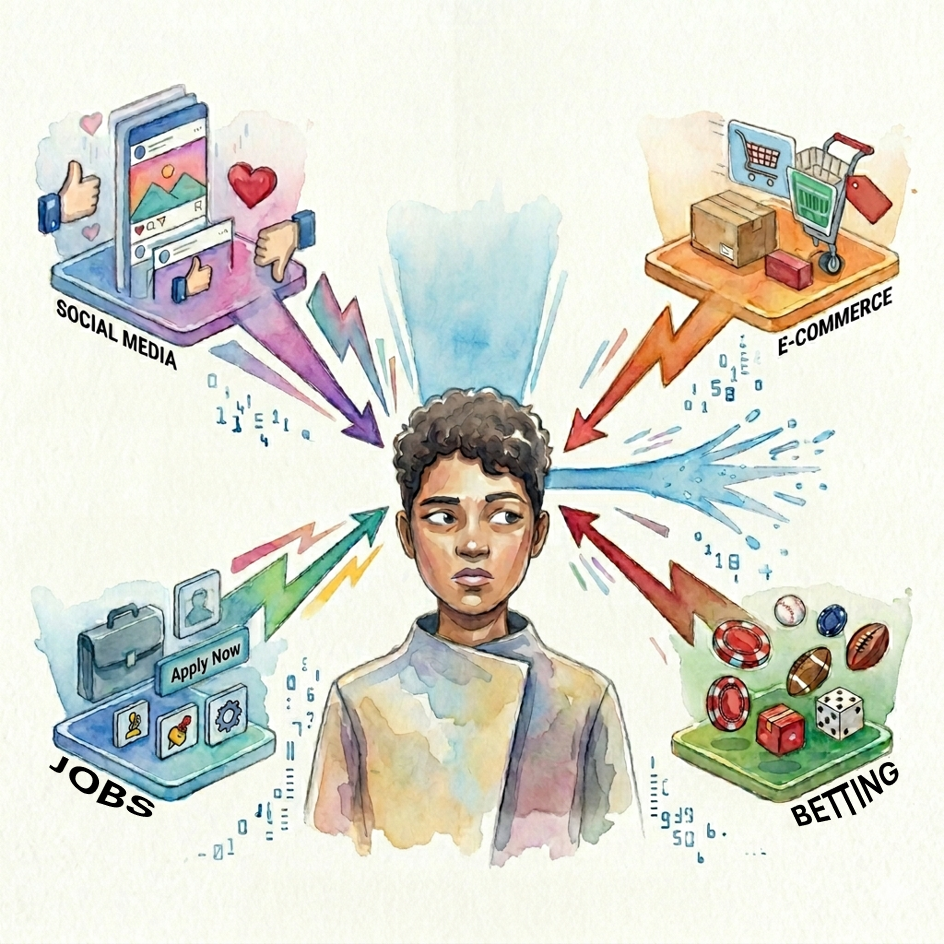
For today's university graduates, the modern job hunt resembles shouting into the digital abyss. Diligent students follow the traditional playbook. They earn good grades, upload tailored resumes to job boards, and click "Apply Now." Then, silence follows. We are tempted to believe the challenge is a lack of jobs. The root cause is a deeper, structural challenge. The digital labor market is undergoing a significant structural transformation due to the vast availability of data, which intersects with a traditional economic dilemma known as the Tragedy of the Commons.
But it is not just the job market. Many modern markets have become dominated by digital "middlemen." Whether e-commerce, sports betting, social connection, or many other digital markets, the tragedy of the data commons has become an all too common market reality.
About the author: Jeff Hulett leads Personal Finance Reimagined, a decision-making and financial education platform. He teaches personal finance at James Madison University and provides personal finance seminars. Check out his book -- Making Choices, Making Money: Your Guide to Making Confident Financial Decisions.
Jeff is a career banker, data scientist, behavioral economist, and choice architect. Jeff has held banking and consulting leadership roles at Wells Fargo, Citibank, KPMG, and IBM.
1. Defining the Commons: From Pasture to Pixels
While popularized by Garrett Hardin in 1968, the conceptual framework of the tragedy dates back to 1833, when Oxford economist William Forster Lloyd modeled the overexploitation of shared medieval pastures. In Lloyd's traditional model, individual users act rationally according to self-interest. They eventually deplete a shared, finite resource because they capture the full economic benefit of consumption while externalizing the structural costs onto the collective. (aka: a negative externality) In the farming example, a common space gets overfarmed, eventually reducing the productivity of the land for all.
When applied to the digital economy, the nature of the commons changes. Because data permits infinite reproduction and lacks rivalry, early information theorists assumed immunity to overexploitation. However, the modern digital economy reveals a modified tragedy. The true constraint in this ecosystem is not the volume of data, but the finite allocation of human attention. As such, the modern challenge is the strategic overfarming of our cognitive bandwidth.
While medieval farmers competed for physical pasture to sustain livestock, modern digital actors compete for human attention. Data abundance effectively creates an attention scarcity. Crucially, today's purveyors of data are dominated by centralized digital "middlemen" who have captured massive market power because of their dominance over the data architectures necessary to run the modern marketplace. Historically, market intermediaries served a vital economic role by reducing transaction costs, mitigating the need for bilateral trust, and providing a necessary common space for trade. However, modern digital middlemen invert this dynamic; by acting as gatekeepers to the attention commons, they introduce heavy transaction costs of their own by explicitly taxing cognitive bandwidth. Ultimately, these intermediaries monetize information congestion, lowering the signal value for users while extracting economic surplus.
This structural distortion occurs frequently across the digital landscape. When the friction of data generation approaches zero, these dominant platforms routinely overcrowd shared information environments, reducing the utility of the marketplace for all participants.
High-profile examples of this phenomenon include:
Social Media (Meta): Algorithms hyper-optimize for engagement, crowding user feeds with sensationalized or algorithmically targeted content to capture finite human focus. By over-farming user attention, the platform degrades the clarity of the social information ecosystem to maximize its highly lucrative advertising data engine.
E-Commerce (Amazon): The digital marketplace is increasingly congested as organic product search results are systematically displaced by data-driven, paid algorithmic advertisements and sponsored listings. Merchants are forced into a costly arms race to buy back access to consumer attention, shifting market power and capital directly to the platform middleman.
Sports Betting and Event Prediction Markets (Kalshi): Real-world events are highly financialized through continuous, data-intensive betting feeds. Platforms leverage real-time behavioral data and constant informational nudges to exploit cognitive biases, transforming a user's analytical focus into hyper-frequent, speculative transactions.
Next, this article examines digital job marketplaces as a primary illustration of the tragedy of the data commons.

2. The Job Market Board as a Polluted Commons
This tragedy plays out explicitly within digital employment marketplaces. Platforms like LinkedIn and Handshake lower transaction costs for applicants and employers to optimize matching efficiency. However, the introduction of generative artificial intelligence disrupts this equilibrium. Because artificial intelligence tools render mass applications effortless, entry-level job submissions tripled between 2022 and 2026.
For the individual student, increasing application volume offers a rational response to diminishing odds. Yet, this behavior triggers a severe congestion externality. As mass applications flood the platform, they crowd the attention commons of corporate recruiters. Overwhelmed human resources departments face limitations reviewing the volume, forcing a large majority of employers to rely on automated screening tools to filter the noise.
"Have Your Bot Talk To My Bot."
This creates what a May 2026 Stanford University study of four million job applications terms the "algorithmic void." The data commons opposes the very users who supply the information. When platforms rely on identical filtering code, an algorithmic rejection at one firm highly correlates with rejections at competitors. Furthermore, these rigid keyword cutoffs introduce systemic proxy discrimination. The Stanford study showed disparate selection rates affecting 26% of Black and 15% of Asian applicants.
3. The Behavioral Trap: Why Seekers Stay in the Over-Farmed Meadow
If the digital meadow suffers thorough degradation, why do job seekers persistently return to the platform? To a behavioral economist, this equilibrium persists due to a combination of misaligned agent incentives and powerful cognitive biases.
The primary market participants navigate an interlocking incentive matrix, which functions as a self-reinforcing loop and accelerates a race to the bottom:
The Platforms: Operating under volume-based revenue models tied to user engagement metrics and corporate subscriptions, platforms face no incentive to curb the influx of applications. They profit from the noise.
The Recruiters: Facing extreme administrative overload, corporate recruiters rely on automated screening due to bounded rationality. They choose the ease of an artificial intelligence filter over the high transaction cost of human sourcing.
The Job Seekers: Applicants face a zero marginal cost to submit one more application, making mass-clicking look rational.
This structural loop creates a race to the bottom. As the platform encourages more applications, recruiters deploy stricter filters, prompting applicants to send even more volume, which further degrades the system.
Beyond baseline incentives, psychological distortions lock job seekers into this counterproductive cycle. First, Availability Bias plays a major role. The "Apply Now" button remains highly visible, structured, and culturally reinforced by parents and peers. This reinforcement makes the button the most mentally accessible path.
Loss Aversion compounds this issue. Stepping away from the platform to build real-world networks requires a high upfront investment of emotional energy. It also carries the threat of social rejection. Job seekers prefer the low-stakes, silent rejection of an algorithm over the active vulnerability of human networking.
Finally, applicants suffer from an Illusion of Control. Pressing a digital button provides an immediate sense of productivity. Conversely, the unadvertised job market operates under extreme information asymmetry. It remains unseen, unstructured, and highly uncertain. Faced with the choice between a highly predictable, low-friction lottery and an unpredictable, high-friction journey, human bias consistently chooses the comfortable futility of the over-farmed meadow.
Conclusion: Bypassing the Void
The traditional, transactional application method yields diminishing returns. Attempting to outsmart automated code in a crowded data commons serves little purpose. Data demonstrates that seventy to eighty-five percent of viable careers exist in the unadvertised, hidden job market. Direct, human-to-human interaction populates this space rather than algorithmic filtering.
For university career services and modern graduates alike, the path forward requires breaking through these behavioral traps. By investing in low-volume, high-touch professional networks, personal client relationship management tools, and authentic human referrals, applicants reclaim informational agency. Interestingly, modern digital marketplaces produce attention-based transaction costs. The alternative is direct, low-volume networking. Yet networking has transaction costs of its own. However, low-volume, authentic human-to-human networking is quickly becoming net transaction cost positive.
Escaping the algorithmic void requires the behavioral courage to leave the crowded, automated platforms and build the positive economics of human connection.


Spot on. As an new grad, I’m exhausted by this zero-cost loop. Time to escape the robo void.