

The AI Locomotive: Why the Safest Place is on the Train

Updated: Apr 24
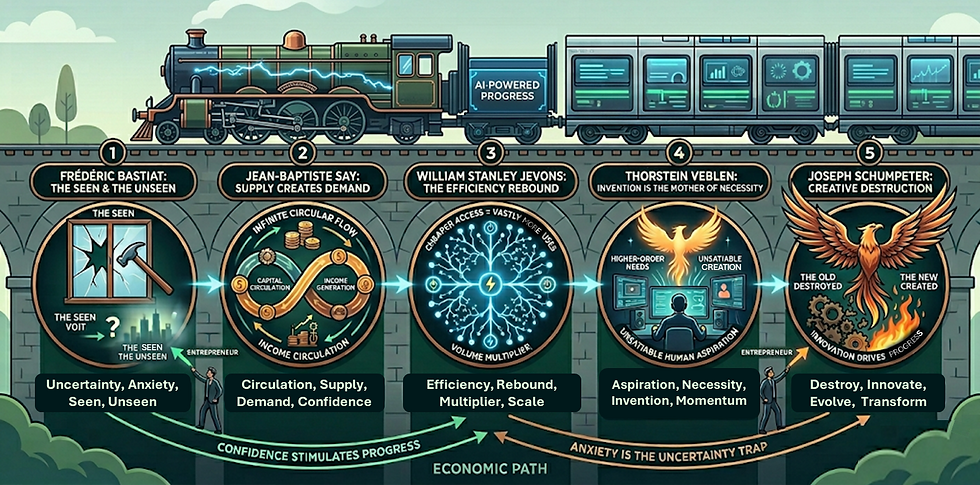
As a behavioral economist, I spend a significant amount of time studying how humans make decisions under conditions of extreme uncertainty. Today, we are facing one of the greatest "uncertainty shocks" in history: the rise of Artificial Intelligence. When people look at AI, they often see a threat to their livelihoods. But I prefer a different metaphor.
AI is a train.
It has left the station, it is gathering immense speed, and it is governed by the immutable laws of economic physics.
Mark Twain famously remarked, "History doesn't repeat itself, but it sure does rhyme." While AI echoes the transformative power of the steam engine or the tractor, it rhymes at a much faster tempo. It is similar in its capacity to expand the economy, but different in the sheer velocity of its disruption.
In this radical transition, you have three choices: get on the train and leverage its momentum, stand on the platform and watch it pass, or stand on the tracks and try to stop it. The third option is the only one that guarantees disaster. For the modern entrepreneur, getting on the train is the best choice, guided by time-tested truths remaining steady even as the world accelerates.
This article discusses the "Big 5." These are 5 giants in economics and sociology providing historical context useful to the AI rhyme.
About the author: Jeff Hulett leads Personal Finance Reimagined, a decision-making and financial education organization. He teaches personal finance at James Madison University and provides entrepreneurial services. Check out his book -- Making Choices, Making Money: Your Guide to Making Confident Financial Decisions.
Jeff is a career banker, data scientist, behavioral economist, and choice architect. Jeff has held banking and consulting leadership roles at Wells Fargo, Citibank, KPMG, and IBM.
The Physics of the Tracks: Say and Jevons
The reason the AI train will create far more value than it displaces is found in the synergy of two classic principles. First, Say’s Law reminds us "supply creates its own demand." When AI makes a service—like coding or legal research—drastically cheaper, it doesn't just "delete" a job. It liberates capital. For the circular flow of the economy to remain healthy, this saved money must be reinvested. It becomes the fuel for the next venture, flowing back into the economy to fund the unseen industries of tomorrow. As an entrepreneur, your role is to be the conduit for this liberated capital, directing it toward new problems that need solving.
Second, the Jevons Paradox suggests we use vastly more of a resource as it becomes more efficient. When technology makes a resource—like "intelligence" or "prediction"—more efficient, the effective cost of using that resource plummets. Critics might argue we will eventually reach a saturation point, but history suggests otherwise. Lowering the cost threshold allows us to do more than just complete old tasks faster; it makes previously impossible projects economically viable. We face an infinite horizon of new, high-complexity projects once considered too expensive to attempt. The tracks favor expansion over contraction.
This isn't just abstract theory; it's the plumbing of our financial system. When AI saves a company money, that capital flows into banks and capital markets, where the money multiplier takes over. Fractional reserve banking turns those savings into the credit that funds the next wave of innovation. The efficiency of AI becomes the liquidity of the future.

The Human Engine: Veblen’s Infinite Horizon
Critics often fear we will reach a point where humans simply have "enough." But as Thorstein Veblen famously noted, "invention is the mother of necessity." Human desire is not a fixed bucket. As AI masters the "commodities" of today, humans will inevitably invent new "necessities." We will move toward higher-order value: empathy, complex strategy, and creative curation. The train isn't heading toward a destination where work ends; it is heading toward a world where the nature of work is more aligned with our uniquely human capabilities.
Consider how the "unthinkable" of the past becomes the "commonplace" of today. A century ago, at the height of the industrial era, the idea of a professional social media manager or an e-sports athlete would have been incomprehensible. To a worker in 1920, "playing a game" or "sharing a thought" were leisure activities—scraps of time rescued from the assembly line. The suggestion that millions would one day earn a living by curating digital communities or broadcasting live gameplay would have been dismissed as a fantasy.
Yet, as previous "trains" of technology automated the survival needs of our ancestors, they didn't eliminate labor; they liberated human attention. We filled that new space with higher-order needs for connection, entertainment, and digital strategy. AI is simply the next engine in this cycle, turning today’s unimaginable activities into tomorrow’s essential careers.
The Bastiat Bias: Fear of the Seen
If the economics are so sound, why the pervasive anxiety? The answer lies in Frédéric Bastiat’s 1850 observation of "the seen and the unseen." We see the "seen" with painful clarity: the specific jobs or tasks being automated and the immediate disruption to familiar routines. However, we struggle to visualize the "unseen": the new industries, the increased purchasing power for consumers, and the entrepreneurial scaling following when capital is liberated from old inefficiencies.
This anxiety stems from an Acceleration Gap. Disruption is a high-velocity event. We feel the "seen" losses in the short term because they are concentrated. Conversely, the "unseen" benefits require time for the plumbing of the economy to reorganize and for new ventures to scale. This creates a temporary period where the old is fading faster than the new is appearing.
The decision of when to board this metaphorical train is deeply behavioral. In my college classes and work with entrepreneurs, I observe how some individuals are naturally more prone to loss aversion than others. Because the friction of the "seen" is happening now, they are tempted to stand on the tracks and protest the train's arrival. This is the ultimate behavioral trap: judging the permanent future by the temporary friction of the transition.
To counter this, I encourage a healthy, active relationship with AI as a viable path to the future. Overcoming the instinct to stay on the platform requires a conscious shift in perspective to look past the immediate horizon. Attempting to "slow down" the train through restrictive regulation doesn't stop the technological shift; it simply ensures the resulting prosperity and innovation happen elsewhere, leaving the hesitant behind.
Schumpeter’s Creative Destruction
Finally, we must acknowledge Joseph Schumpeter’s "Creative Destruction." This principle dictates the old must make way for the new. This process creates the friction causing our current discomfort. However, this gale of innovation also serves as the source of all progress. To be an entrepreneur in the AI era means practicing Creative Destruction daily. It requires the courage to abandon "how we’ve always done it" to make room for "how it can be done now."
AI disrupts Corporate America at its core. Legacy systems and rigid hierarchies often fail to adapt to this new velocity. While large institutions struggle with institutional drag, agile entrepreneurs occupy the inevitable gaps. These entrepreneurs define the new landscape by turning the wreckage of outdated models into the foundation of the future.
Conclusion: Pick Your Position
The AI train is coming. It is fueled by the circular flow of Say, the scalability of Jevons, and the insatiable human nature described by Veblen.
Standing on the platform by ignoring AI is a recipe for irrelevance. You may stay safe for a moment, but the world will move on without you.
Standing on the tracks by trying to block or stall the transition is a recipe for ruin. The economic momentum of efficiency is a force no policy or protest can truly stop.
Getting on the train by integrating AI into your workflow, your business model, and your decision-making is the only way to harness the power of this transition.
In the world of behavioral economics, the best decision is the one that aligns with reality. The reality is that the "unseen" world AI is building will be wealthier, faster, and more creative than the one we are leaving behind. It’s time to get on the train. The tracks are clearing, the engine is roaring, and the future is waiting.


Thanks for highlighting many relevant economists and how to think about AI. It is scary as jobs are lost....