

Why Your Brain Hates Wealth: Overcoming Loss Aversion in Financial Decisions

Updated: Jun 24

Our biology primes individuals to prioritize avoiding losses over achieving gains. This evolutionary setting helped preserve survival in primitive conditions, but it often creates friction when applied to modern wealth management. Modern wealth accumulation requires individuals to move past these instinctual defaults.
This article examines the mechanics of loss aversion, the variable nature of individual risk thresholds, and the psychological traps that lead even well-educated minds to rationalize suboptimal choices. By understanding how early environments shape economic perspectives, decision-makers can utilize systemic safeguards to neutralize cognitive bias. Our goal is to help people build long-term wealth and achieve personal sovereignty.
When it comes to overcoming the negative impact of loss aversion, people should embrace:
Ruin and risk are 2 very different ideas.
An activity leading to ruin is to be avoided.
An activity unlikely to lead to ruin but having some risk is to be understood.
Seek to expose yourself to the appropriate risk.
The default has risk. Not making a decision is a decision
Aligning Evolutionary Biology With Modern Choice
Imagine entering a room where an individual offers a simple coin flip. Heads yields a gain of $200; tails demands a payment of $100. Mathematically, this opportunity offers a highly favorable expected value. Yet, a large majority of individuals decline the wager.
This hesitation stems from a powerful, predictable, and deeply embedded force in human psychology: loss aversion.
Popularized by behavioral economists Daniel Kahneman and Amos Tversky, loss aversion highlights a pattern in human behavior where losses generate greater psychological impact than equivalent gains. The emotional discomfort of losing $100 typically scales to twice the intensity of the satisfaction gained from acquiring $100.
In the mathematics of decision-making, this psychological asymmetry occupies a variable known as the Lambda coefficient (λ). When estimating human choices, researchers observe a baseline Lambda average of approximately 2.25. This coefficient indicates the human brain multiplies the emotional weight of a potential negative outcome. Because individuals seek protection from this amplified discomfort, choices frequently favor the status quo, which limits engagement with advantageous opportunities.
(In the article's lead image, Lambda is the ratio of the red loss area divided by the smaller green gain area.)
Our loss aversion has an ancient starting point, rooted in our evolutionary biology and how humans survived thousands of years ago. However, this average serves as a genetic starting point rather than an absolute rule. Individual Lambda values fluctuate based on personal history, current environment, and cultural background.
The Decision Dilemma: Lambda in Wealth Management
To understand how this mathematical relationship describes behavior, consider a frequently occurring real estate scenario. A couple whose children have reached adulthood evaluates whether to sell or rent their family residence. Analysis of the situation reveals strong financial metrics:
The existing fixed mortgage carries a historic low interest rate.
The monthly mortgage obligation falls well below the current market rent. In other words, renting creates an immediate positive cash flow.
The property sits within a highly stable rental market.
The asset appreciates at an appealing annual rate and has shown long-term resilience.
From an objective economic standpoint, retaining the property as a rental asset offers substantial long-term value. The property generates consistent income and builds equity efficiently.
Yet, despite the clear data, the owners hesitate. They experience significant discomfort regarding the responsibilities of property management. To an external observer, the potential for a vacant month or a maintenance request represents a very manageable operational or financial friction, especially given the upside. To the owners, however, because it was their home, they naturally overvalued its current condition; they have concerns about property management as a mental tax rather than a standard operational or financial cost. In short, they struggle with the mental transition from their house as a home where they raised their family to a house as a business.
This reaction demonstrates Lambda in action, their "red" fear of loss space is bigger than their "green" happy financial gain space. Their Lambda is likely intensified by individual framing. For instance, childhood upbringing heavily shapes financial perspectives. If these individuals were taught to view mortgage debt as an inherent threat to security or a burden, they likely associate true financial freedom with a paid-off home. Objectively, this specific scenario contradicts their cultural programming. The low-cost mortgage provides an inexpensive source of capital, which maximizes their long-term financial security.
Because their early environment framed debt negatively, this couple likely possesses a Lambda baseline far higher than the 2.25 average. Their brains discount the compounding trajectory of long-term gains and focus primarily on loss fears. This perspective is VERY COMMON. Many Americans were brought up to believe "debt is bad." It turns out, while some debt is bad, some low-interest-rate debt can be incredibly helpful. Consequently, many individuals decline advantageous financial paths because the familiar option reduces immediate psychological stress. That is, selling just "feels" better.

Understanding the Psychology, Adjusting the Default
Because of loss aversion, behavioral economic models demonstrate that what we traditionally call "risk aversion" is actually driven by a baseline fear of losing what we already hold. Throughout human history, this orientation has preserved life. In primitive environments, a significant loss threatened survival, whereas a substantial gain merely increased comfort. In the caveman days, it was better to be poorer and alive than rich and dead. Evolution reinforced conservative behavior. Of course, today is different. Unless there is a jailbreak at the local zoo, those "fight or flight" threats have been practically eliminated in the modern world, but our brains still operate on the ancient wetware. Today's narrative: It is better to be rich and alive, but we need to get out of our own way first!
Overcoming this internal programming requires recognizing its origin. Loss aversion reflects an evolutionary baseline rather than a personal deficiency or a lack of intelligence. In fact, intelligence itself can be its own cognitive bias, called "motivated reasoning" or the "intelligence trap."
A profound difference separates a default condition from an unalterable destiny. Baseline settings do not dictate long-term outcomes. Successful entrepreneurs, innovators, and wealth-builders possess the same psychological architecture as others. However, these individuals learn to recognize their default programming and actively apply structural adjustments to their decision-making process. These wealth-builders are better able to manage their emotions by decoupling the two: they accept risk exposure (uncertainty in market outcomes) because they have actively neutralized their loss aversion (the instinctual fear of falling below a specific reference point).
High-Impact, High-Lambda Financial Decisions
Individual environments, family upbringing, and cultural narratives can artificially elevate Lambda, causing individuals to experience heightened friction during critical economic choices. Earlier, we discussed the rent versus sell real estate decision as a prototypical high-Lambda example.

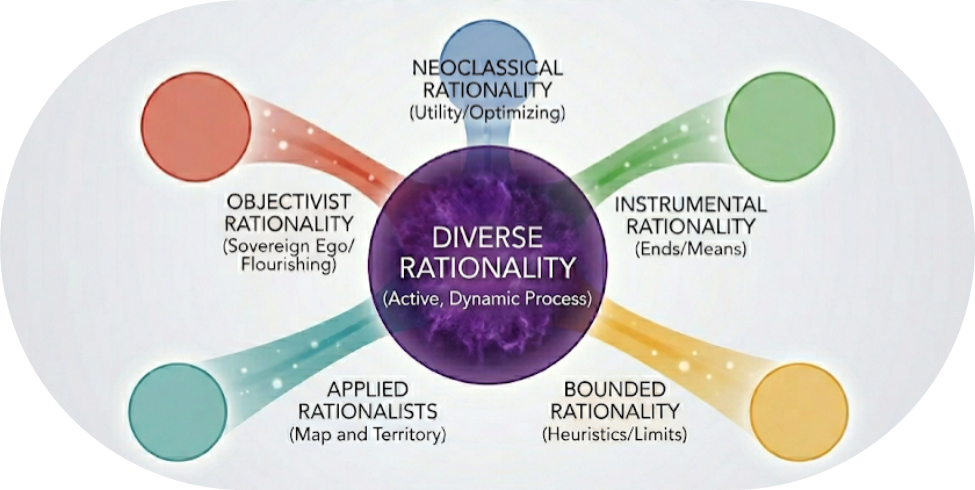
This variance reflects our naturally occurring diverse rationality, a framework demonstrating that individuals possess unique preferences, distinct life experiences, and subjective valuations. Because rationality remains user-defined rather than a single standardized metric, unique high-Lambda decisions occur as a normal consequence of human diversity. An elevated Lambda baseline does not make default beliefs incorrect, but it does suggest that individuals should carefully inspect underlying assumptions and utilize structured decision processes.
The following table details five more high-impact financial scenarios where structural or social conditioning systematically inflates the perception of risk.
Scenario | The Objective Value Proposition | Cultural or Environmental Driver | Elevated Lambda Reaction |
Selecting a Medical Imaging Provider | Magnetic Resonance Imaging (MRI) represents a standardized diagnostic service with substantial price variance across facility types, allowing patients to reduce out-of-pocket expenses by choosing independent imaging centers over hospital systems. | Cultural conditioning associating hospital systems with superior diagnostic accuracy, combined with a default deference to physician referral networks. | The patient multiplies the perceived health risk of using an independent facility, viewing alternative options as a threat to personal safety and electing to accept significantly higher hospital facility fees. |
Selecting Alternative Higher Education Pathways | Utilizing community college partnerships or regional state universities significantly reduces total tuition expenditures while yielding long-term career outcomes comparable to selective institutions. (Dale and Krueger) | Cultural or parental conditioning associating institutional prestige and elite brand names with guaranteed professional success. | The student and parents over-index on the potential loss of social status or perceived network quality, choosing substantial debt burdens over structurally equivalent educational outcomes. |
Transitioning from Corporate Employment to Entrepreneurship | Launching a validated business venture often yields asymmetric upside, equity ownership, and long-term autonomy. | Upbringing by risk-averse parents who prioritize institutional stability and steady, predictable paychecks. | The individual multiplies the emotional weight of losing a steady salary, treating the transition as a threat to basic survival rather than a strategic allocation of human capital. |
Shifting Cash Savings into Low-Cost Index Funds | Long-term equity markets historically outpace inflation, protecting purchasing power and compounding wealth efficiently over multi-decade horizons. | Exposure to family members who lost capital during severe market downturns, or growing up in an environment lacking financial literacy. | The investor views short-term market volatility as an immediate, permanent destruction of capital, preferring the certain, slow loss of purchasing power via inflation. |
Relocating to a High-Cost, High-Opportunity Urban Hub | Moving to a major metropolitan area increases exposure to specialized industries, higher salary scales, and robust professional networks. | Deep cultural ties to a specific geographic region, or a community narrative associating major cities with prohibitive expenses and social isolation. | The professional over-indexes on the immediate, certain increase in rent and living costs, ignoring the probabilistic, long-term acceleration of career growth. |
Recalibrating the Internal Risk Formula
To navigate beyond standard loss aversion, it is essential to recognize: Willpower is NOT enough. Successful decision-makers actively reframe their choices through specific strategies:
Redefining the Nature of Loss: While the standard perspective focuses on the immediate friction of a vacancy or a problematic tenant, the entrepreneurial mindset views the abandonment of opportunity as the primary loss. Giving up the property guarantees the loss of passive income, long-term equity, and future financial flexibility.
Utilizing External Safeguards: Innovators navigate environments designed to moderate the consequences of a negative outcome. For example, the legal and economic architecture of the United States serves as a structural counterweight to Lambda. Frameworks like the Limited Liability Company (LLC) shield, structured bankruptcy protections, and tax code provisions for loss deductions lower the objective penalty of a setback. These institutions reduce systemic friction, which helps mitigate the brain's natural aversion to uncertainty.
Decision Consistency: Use a consistent, repeatable decision system to make high-impact decisions. This combines learning about financial decision-making and using choice architecture technology, the decision tech of behavioral economics. Behavioral economics provides several methods to manage our default loss aversion. This includes choice architecture, nudges, managing sludge, and commitment devices.
Decision Information: Naturally, decision information matters, but between GenAI and advisors, that information is easily available. Like in the earlier example, the couple can easily determine the 4 or 5 pieces of information about mortgage interest rates, home appreciation rates, tax advantages, and rental opportunities. As an interesting commentary on the modern world, the value of financial advisors is not so much their technical knowledge. It is more so their behavioral knowledge to help you make the best decision. Historically, financial advisor certifications like the CFP have focused almost entirely on technical data. Despite recent shifts to include behavioral coaching, the industry's credentialing still stubbornly emphasizes the math over the mind. Ultimately, information is not the primary challenge. The true challenge is developing a decision process to overcome loss aversion.

Management of Strategic Choices
Overcoming loss aversion requires a transition from passive reaction to deliberate calibration. The human brain frequently amplifies minor risks into severe threats. By recognizing this instinct as an evolutionary legacy, and by utilizing analytical frameworks alongside established legal protections, individuals can systematically manage their choices. Biology establishes the initial starting point, but deliberate execution defines the ultimate path.
Of course, at the end of the day, we have to do what works for us and make the decisions that we are comfortable living with. But we do have choices. Once we understand how our brains operate, loss aversion can be proactively managed. This allows us to update and improve our relationship with risk and money.
Developing a consistent, repeatable decision system is essential for developing long-term wealth and achieving personal sovereignty.
About the author: Jeff Hulett leads Personal Finance Reimagined, a decision-making and financial education organization. He teaches personal finance at James Madison University and provides entrepreneurial services. Check out his book -- Making Choices, Making Money: Your Guide to Making Confident Financial Decisions.
Jeff is a career banker, data scientist, behavioral economist, and choice architect. Jeff has held banking and consulting leadership roles at Wells Fargo, Citibank, KPMG, and IBM.
Resources
For more information on high Lambda, please see the articles on Diverse Rationality and Adam Smith.
Appendix: The Mechanics of Choice
Daniel Kahneman and Amos Tversky revolutionized economics by translating raw human behavior into formal equations. Behavioral economics is rooted in psychology, yet its predictive power relies on precise modeling. The following steps deconstruct Cumulative Prospect Theory from the bottom up. Every complex mathematical layer serves as a formal translation of a natural human instinct. Our biology drives the choreography; the math provides the script.
We seek to make the math intuitive. The power of Prospect Theory is in the work done to estimate the shape of the S-Curve, which is the basis for loss aversion. It was experimentally rendered. The S-Curve is specified using power functions and coefficients like alpha, beta, and lambda. The S-Curve is embedded in the following notation:

The Dance Choreography (Bottom to Top)
Step 1: The Split Foundation (PT1)
Intuition leads: Brain divides choices into "gains" and "losses" relative to right now.
Math follows: Splits the equation into a positive side (+∞) and a negative side (-∞).
Step 2: Value Meets Weight (PT2)
Intuition leads: Our sensitivity numbs as amounts grow, and we warp the percentages.
Math follows: Multiplies the value curve du(x) directly by the weight curve w(F(x)).
Step 3: The Ranking Twist (PT3)
Intuition leads: A 1% chance changes meaning depending on if it's the top prize or a dud.
Math follows: Sorts outcomes from worst to best before assigning final weights.
Step 4: The Percentile Sweep (PT4)
Intuition leads: Let's scan the gamble from the 0% worst-case to the 100% best-case scenario.
Math follows: Sweeps across percentiles (dp) rather than dollar amounts.
Step 5: The Concrete Lottery (PT5)
Intuition leads: Swap the calculus curves out for a real-life physical raffle ticket.
Math follows: Changes smooth integrals (∫) into simple, distinct steps (Σ).
Step 6: Continuous Markets (PT7)
Intuition leads: Look at continuous, smooth wavy risks like stock market volatility.
Math follows: Brings back calculus to hyper-focus on the thin, extreme tails of a distribution.
Step 7: Hybrid Reality (PT8)
The Grand Finale: Both partners dance perfectly in sync. The math blends smooth integrals and distinct lottery steps together to price messy, complex real-world risks.


Thanks! Love the practical application of behavioral economics!