

From Moral Philosophy to Choice Architecture: Closing the 'Unseen' Gap in Adam Smith's System

Updated: Dec 17, 2025
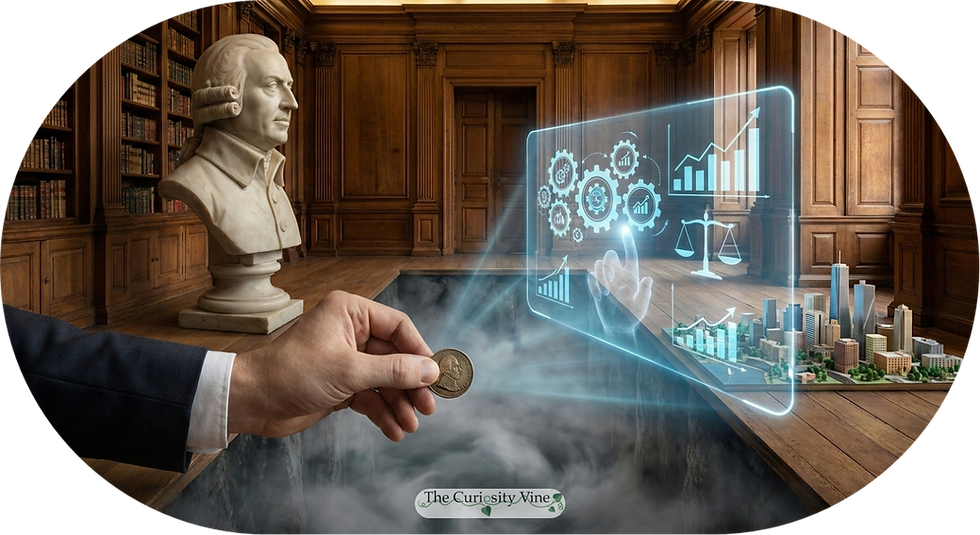
Adam Smith’s enduring legacy rests on two pillars: the moral philosophy detailed in The Theory of Moral Sentiments (TMS) and the economic framework of The Wealth of Nations (WN). For decades, the intellectual divide between these works—dubbed the "Adam Smith Problem"—obscured a critical truth: the two books form a single, cohesive system.
The key to unification lies in Smith’s four sources of moral approval from TMS. The first three sources (motives, consequences, and general rules) facilitate resonance in personal, face-to-face interactions. However, the fourth source—the Approval of the System’s Utility—involves a deeper alignment. It is the moral appreciation of an action’s fitness to promote the long-term, systemic welfare and order of society—the "unseen" benefits. Smith realized demonstrating this vast, impersonal social utility required an entire work dedicated to its mechanism.
The Wealth of Nations is the mechanism.
It is the systematic case self-interested behavior, channeled by justice, leads to the extraordinary, unintended prosperity, justifying commercial society on moral grounds.
Quick Review: Smith’s Four Sources of Moral Approval
To understand this unification, we briefly recall Smith’s four sources of moral approval (alignment), framing them through an economic lens:
Approval of the Agent's Motives (Supply): Assessing the propriety of the actor’s intentions. (e.g., Was the butcher trying to be honest?)
Approval of the Action's Effect (Demand): Assessing the harmony of the recipient’s reaction (gratitude or resentment). (e.g., Does the customer feel a sense of fair exchange?)
Approval of the General Rules (Stated Laws and Customs): Assessing the fitness of the act against laws and social norms. (e.g., Does the transaction sit in equilibrium with sanitation laws or market customs?)
Approval of the System’s Utility (The Unseen): Approving the action based on its contribution to the beauty of systemic outcomes. (e.g., Does the butcher’s process, when scaled up, sustain the nation’s wealth?)
The challenge for Smith involved demonstrating the moral acceptability of this fourth, system-wide outcome.
The Scholars on Smith’s Unified Vision
Leading scholars making productive use of Smith’s work share a fundamental orientation positioning The Wealth of Nations as the essential study of the 4th source of moral alignment:
Mike Munger (Duke University): Munger argues WN addresses the problem of scale. While TMS covers moral behavior in small "moral communities" (where sympathy works), WN explains how the impersonal market—the Invisible Hand—generates moral authorization for a massive society where we cannot know or empathize with everyone.
Daniel Klein (George Mason University): As a leader in the "Humanomics" project, Klein stresses WN reveals the System of Natural Liberty as the engine yielding the vast social benefits required by the 4th source. The moral framework of TMS (Justice) acts as the necessary pre-condition for realizing the economic benefits of WN (Utility).
F.A. Hayek (Nobel Laureate): Hayek’s concept of Spontaneous Order is a 20th-century refinement of the Invisible Hand, the mechanism of the 4th source. He demonstrated how the market coordinates the dispersed knowledge of millions through prices, creating an "order" resulting from "human action but not of human design"—the ultimate evidence of system-wide utility.
James Buchanan (Nobel Laureate): Buchanan’s Public Choice theory focuses on the risk of government overreach in the 3rd source (General Rules/Laws). He applied the self-interest model to political actors, cautioning government is prone to overstepping, thus generating regulations diminishing liberty. He argued the social benefits of the 4th source (Utility) rely on the state finding an appropriate constitutional balance. On the one hand, the government constrains individual power enough to prevent injustices such as those related to commutative justice. But, on the other hand, not so much as to suppress the autonomy necessary for market prosperity.
Thomas Sowell (Hoover Institution): Sowell’s "Constrained Vision" is fundamentally Smithian. He emphasizes the systemic prosperity generated by the market results from unintended consequences (re: incentives and constraints), not intentional design. The market’s utility (the 4th source) is superior precisely because it incorporates more knowledge than any single central planner could possess.
Personal Finance Reimagined and the 4th Source Gap
While The Wealth of Nations demonstrated the market system is inherently good for society (high utility/4th source), it left the individual agent with a practical challenge:
How do I personally participate in the Invisible Hand to optimize my self-interest while ensuring alignment with social utility?
The reason for this difficulty is a characteristic of achieving 'benefit to all.' The high social utility of the 4th source is an emergent future feature of the market system, based on the myriad interactions and decisions needed by agents today. This outcome is not guaranteed or planned; it simply emerges from the collective decentralized choices guided by the Invisible Hand. Thus, at the time a decision needs to be made, the social utility of the 4th source is challenging to anticipate.
It takes a leap of faith.
The very nature of the 4th source holds the beneficial outcome unseen by the individual at the moment of choice. Therefore, the best we can do involves making decisions based on our current and anticipated utility and maintaining confidence the market system will guide an outcome, making all agents collectively better off.
Furthermore, we must appreciate our personal utility is the subject of a belief updating process. Bayesian Inference, while not always followed perfectly in human behavior, stands as the core mechanism describing how people should update their beliefs based on new evidence. As our personal circumstances, or the actions of other market agents, are revealed, we respond by updating our beliefs and subsequently changing our market choices (like what we buy). Modern decision-making, especially in personal finance, often involves complexity and inertia making optimizing individual outcomes—the first step in maximizing social utility—difficult.
The Foundation: Diverse Rationality
Neoclassical economic models rely on the assumption of a single, uniform model of "economic man" (Homo Economicus)—a perfectly rational, self-maximizing agent. This tradition, which dominated the 20th century, treats the individual as a "utility computer" capable of processing perfect information to find a singular, optimal equilibrium.
PFR rejects this homogenous view, instead embracing the concept of Diverse Rationality. This perspective is grounded in neurobiology and behavioral psychology, recognizing every individual possesses unique cognitive wiring, emotional responses, and personal history shaping their values, preferences, and self-control. Our approach recognizes people express diverse rationality both across space and over time. This reinforces the need for a robust belief updating system as mentioned earlier.
Because individual rationality is fundamentally diverse, a one-size-fits-all financial solution fails. PFR’s approach acknowledges optimal decision-making requires understanding the individual’s specific map of self-interest, a complex blend of both selfish and selfless motivations.
PFR Closes the 4th Source Gap
PFR acts as a modern choice architecture system empowering individuals to close this gap by making the Invisible Hand’s principles more visible at the individual level.
PFR is a practical application of Smith’s framework helping people optimize their choices under the 4th source of moral approval by:
Mapping Comprehensive Self-Interest: Built on the principle of Diverse Rationality, PFR helps individuals map their complete preferences, which include both selfish (immediate wants) and selfless (long-term, moral, or altruistic goals). This structured mapping process ensures the individual’s motivation (the 1st source: Approval of the Agent's Motives) is fully informed and aligned with their unique, highest values.
Clarifying Personal Utility: Understanding one’s true utility—the grounding for the 2nd source (Approval of the Action's Effect)—is often difficult due to cognitive biases and dynamic preferences. PFR’s framework and technology helps individuals clarify what truly yields them satisfaction, enabling the most appropriate utility assessment at the time a decision needs to be made.
Clarifying Unseen Consequences: By providing a structured process evaluating trade-offs and visualizing long-term impact (e.g., compounding interest, financial freedom), PFR transforms the "unseen" outcomes of small, daily decisions into visible data points. This brings the abstract concept of Utility (the 4th source) down to a personal, actionable level, allowing the agent to choose actions with demonstrably higher long-term utility.
Empowering the Impartial Spectator: The PFR process encourages a reflective pause, serving as a modern implementation of Smith’s Impartial Spectator—or, more accurately, the "Man Within the Breast." PFR’s technology enables the conscious invitation of this internal judge. By enabling the user to deliberate and justify their choices against their mapped values before acting, PFR ensures the action aligns with their own highest standards and external rules, thereby satisfying the necessary moral precondition for participating productively in the market system.
In short, PFR acts as a choice architecture system empowering individuals to internalize and act upon the same principles of optimization Smith demonstrated working for the entire economy. By providing practical tools for individual choice structurally aligned with utility, PFR helps agents satisfy the 4th source of moral approval, making the personal invisible hand more visible and creating better outcomes for both the agent and the larger commercial society.
To learn more about PFR resources, including our book and technology, please see this link.
Resources for the Curious
Anchoring sources from Jeff Hulett:
Hulett, Jeff. “Becoming Behavioral Economics: The Social Science Revolutionizing Decision-Making.” The Curiosity Vine, November 7, 2023.
Hulett, Jeff. “Adam Smith and how choice architecture makes the invisible hand more visible.” The Curiosity Vine, July 9, 2023.
Sources: Smith, Adam. The Theory of Moral Sentiments. A. Millar, 1759.
Smith, Adam. An Inquiry into the Nature and Causes of the Wealth of Nations. W. Strahan and T. Cadell, 1776.
Munger, Michael. “Adam Smith’s Two Books: You Can’t Have One Without the Other.” Adam Smith Works, July 29, 2025.
Klein, Daniel B., and Erik Matson. “What’s Natural about Adam Smith’s Natural Liberty?” Adam Smith Works, March 23, 2022.
Hayek, Friedrich A. “The Use of Knowledge in Society.” The American Economic Review, 35(4), 1945, 519-530.
Buchanan, James M., and Gordon Tullock. The Calculus of Consent: Logical Foundations of Constitutional Democracy. University of Michigan Press, 1962.
Sowell, Thomas. A Conflict of Visions: Ideological Origins of Political Struggles. William Morrow, 1987.
Bastiat, Frédéric. "That Which is Seen, and That Which is Not Seen." Journal des Économistes, 1850.
Jaynes, E. T. Probability Theory: The Logic of Science. Cambridge University Press, 2003.
McCloskey, Deirdre N. The Bourgeois Virtues: Ethics for an Age of Commerce. University of Chicago Press, 2006.


Comments