

Doing the Right Thing When Everyone Is Looking: The Economics of Moral Conviction

Primary moral education relies upon a foundational premise: individuals build character by choosing ethical actions without external oversight. While childhood training focuses on strengthening an internal moral observer, adult decision-making inside complex institutions operates under fundamentally inverted conditions. In mature professional, civic, and political environments, choices occur under constant peer visibility, organizational scrutiny, and career risk.
This paper bridges Adam Smith’s classical model of the Impartial Spectator with Douglass North’s institutional economic framework regarding the price of expression (Px). It demonstrates how public visibility elevates external institutional penalties, often overriding an individual's internal moral sentiment. When organizations impose high professional costs for standing up, even highly principled individuals default to group compliance over personal judgment. Ultimately, the analysis demonstrates why ethical leadership requires going beyond calls for individual courage, focusing instead on building low-cost institutional structures that allow personal conviction to guide organizational choices.

Elementary school moral education often rests upon a traditional gold standard: "Do the right thing when no one is looking."
In primary schooling, external oversight remains common. Parents, teachers, and administrators monitor school halls and recreational spaces. Primary moral training focuses on building an internal compass capable of functioning if external supervision falls away.
As adults, however, we encounter an inverted reality. The primary test of character in mature institutions seldom involves private personal choices. A far greater challenge centers on doing the right thing in high-visibility settings under broad peer observation.
When public visibility increases, social pressure, organizational protocol, career risk, and peer scrutiny construct heavy institutional barriers. Understanding why adults hesitate in these public moments requires bridging two foundational ideas: Adam Smith’s classical moral philosophy and Douglass North’s modern institutional economics.
1. Adam Smith and the Baseline Observer
In The Theory of Moral Sentiments (1759), Adam Smith introduced the concept of the Impartial Spectator. Smith described an imagined, neutral third-party observer residing within our minds. Human self-governance relies on evaluating personal choices through the eyes of this internal judge.
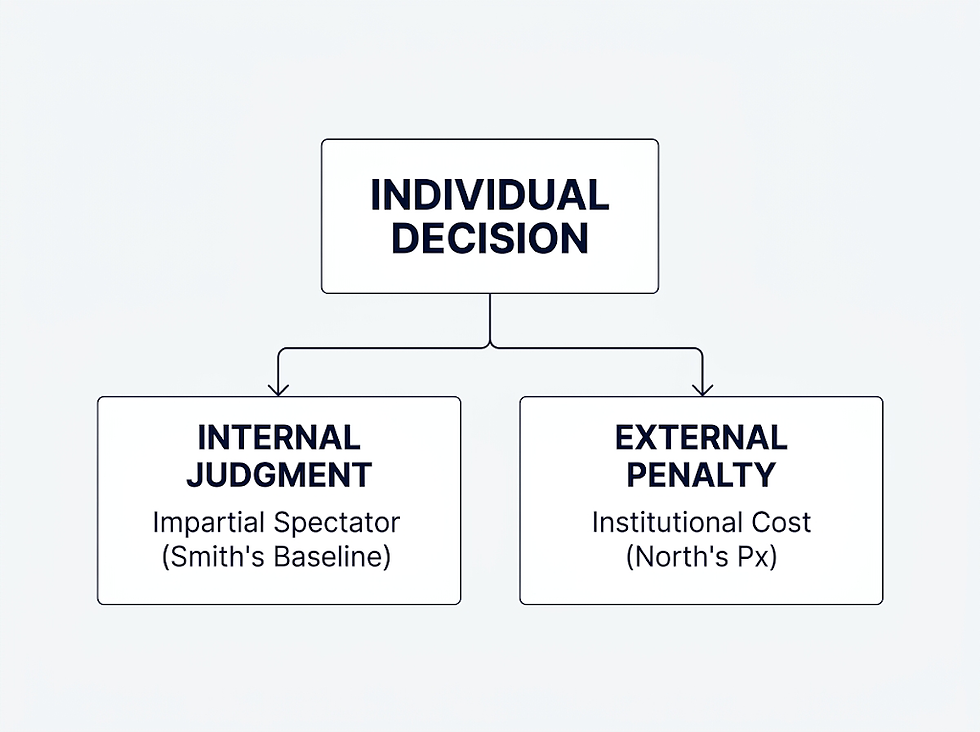
The Impartial Spectator imposes an internal cost: guilt, remorse, or a loss of self-respect following a departure from personal standards.
This internal judge explains the primary objective of early childhood moral training. When educators encourage young students to "do the right thing when no one is looking," they actively help children construct and strengthen their Impartial Spectator.
When an individual acts largely unmonitored, external penalties for poor choices approach zero. The primary cost stems from the internal psychological cost levied by the Impartial Spectator. Early moral education succeeds by fortifying this internal observer, helping ensure personal accountability remains strong even as external oversight decreases.
2. Douglass North and the Institutional Price (Px)
Two centuries after Smith, Nobel laureate Douglass C. North examined how formal rules and informal norms shape human choices. North identified a core economic dynamic: while individuals hold personal convictions, expressing those convictions depends heavily on the institutional price (Px) attached to them.
Total Cost of Deviation = Internal Cost (Impartial Spectator) + External Institutional Price (Px)
North observed a fundamental economic relationship governing personal conviction: as the price (Px) of expressing a conviction rises, personal conviction becomes a weaker determinant of actual choices.

When institutional penalties (Px) for speaking out—such as career friction, social isolation, or organizational non-compliance—reach elevated levels, individuals move down their utility curve. They soften personal moral convictions to manage external costs, defaulting to group compliance over individual judgment.
3. The Adult Inversion: High Px Environments
Why does doing the right thing under public scrutiny present such a persistent challenge for working professionals? High visibility substantially elevates Px.
Inside corporate, governmental, and civic institutions, visibility carries immediate operational consequences:
Career Trajectory: Deviating from group consensus can complicate future project funding, promotion opportunities, or ongoing employment security.
Social Proof and Group Harmony: Public settings trigger natural desires for team alignment, raising the personal cost of dissent.
Procedural Inertia: Formal institutions operate to maintain stability and lower daily coordination overhead, frequently penalizing individuals challenging established protocols.
When professionals remain silent during team meetings, look past operational flaws, or follow questionable directives, their internal Impartial Spectator has not vanished. Rather, the institutional price (Px) of speaking out has outpaced their internal moral baseline.
Designing Low-Cost Institutions for Moral Leadership
Because personal conviction influences choices through institutional costs, moral leadership rarely succeeds by simply urging individuals to display greater personal courage. Effective institutional design focuses on altering the price curve itself.
Lowering the Price of Voice (Px): Forward-thinking organizations construct psychological safety, clear reporting channels, and open debate forums specifically engineered to minimize the career cost of voicing conviction.
Aligning Rules with Conviction: When institutional incentives actively reward transparency and constructive feedback, the external price (Px) drops, allowing personal conviction to become a primary driver of organizational behavior.
While childhood education focuses on strengthening the Impartial Spectator inside the individual, adult leadership focuses on building institutional systems allowing that internal spectator to speak without incurring steep personal costs.


Comments