

Architects of the Enrichment: How Jefferson, Smith, Madison, and Hamilton Built the Modern World

Updated: Mar 23

The Case for Keeping the Faith
It is remarkably easy to get discouraged by today's headlines. When we look at political division or the lingering injustices of our world, it’s tempting to think we are backsliding. The data tells a completely different story. A story we should be proud of and a story that should motivate us to do and be better.
As Billy Joel famously sang in Keeping the Faith,
"The good old days weren't that good, and tomorrow ain't as bad as it seems."
At the time of our founding, the "good old days" were often brutal. Most families lived with the constant shadow of death; losing a child was a common occurrence, not a statistical anomaly. Disease was a constant threat, and physical pain was an inescapable part of daily life. Work was not a career, but a back-breaking struggle for survival, and the specter of hunger was never far away.
The "Great Enrichment" of the last 250 years has changed the human condition in ways that would have seemed like magic to our ancestors. Today, the average person lives with comforts, technologies, and medical safety that would have been the envy of the kings of the 1700s.
The following is a retrospective about why this happened, how our country was founded to enable it, and why the ultimate challenge of the next 250 years may be overcoming our own evolutionary programming to embrace the abundance we’ve created.
Quarter-Millennium: The Unfinished Symphony of 1776
The Spark of Defiance: A Tale of Two Revolutions
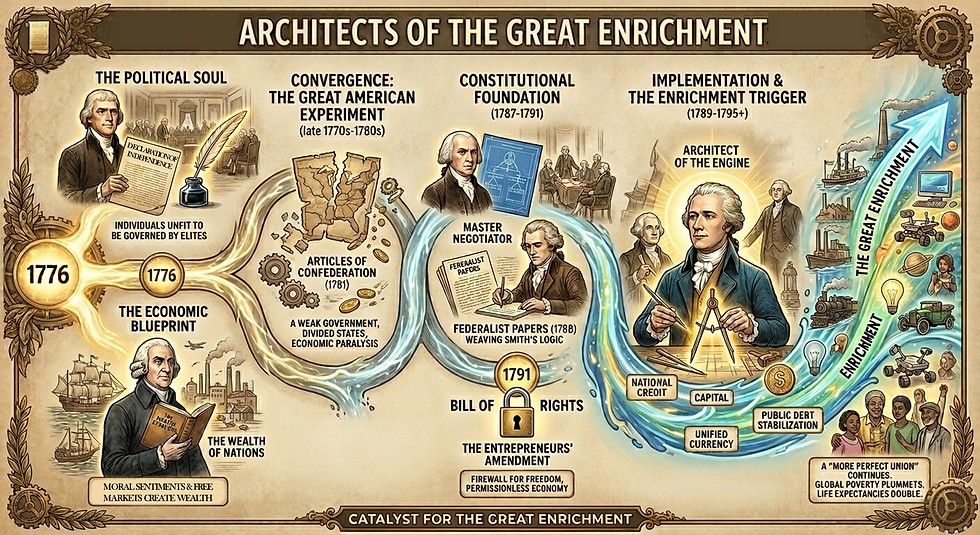
Two hundred and fifty years ago, the trajectory of human history was irrevocably altered by two world-changing events occurring at almost the exact same moment. In 1775, the first shots echoed at Lexington and Concord, sparking a war for political survival. By 1776, as Thomas Jefferson dipped his pen to draft the Declaration of Independence, a quiet Scottish philosopher named Adam Smith was publishing The Wealth of Nations across the Atlantic.
This synchronicity was no accident. Both men were attacking the same enemy: the idea that an elite few should control the lives and livelihoods of the many. While Jefferson provided the political soul of the revolution by breaking away from the world's most powerful empire, Smith provided the economic blueprint. Together, they forged the radical idea that individuals, not distant elites, are best equipped to govern their own lives and their own economic destinies. This is the story of how those two revolutions converged to forge the Great American Experiment.
The Morning After: A House of Cards
The victory in the Revolutionary War in 1783 led to a startling realization: America was "free," yet it was also divided. The first attempt at a blueprint—the Articles of Confederation (ratified in 1781)—was a disaster.
Born of a deep fear of kings, the Articles created a government so weak it couldn't even pay its own soldiers. The "United" States were 13 bickering mini-nations with their own currencies and trade barriers. The dream was collapsing because it lacked a unified economic vision.
The Architects: Washington, Madison, and Hamilton
In the sweltering summer of 1787, the Constitutional Convention met in Philadelphia to save a dying union. While George Washington’s presence provided the moral gravity needed to keep the delegates in their seats, the intellectual engine of the room was James Madison.
Madison was the Master Negotiator. Having spent years studying the failures of ancient republics, he arrived with a comprehensive plan for a new government already in hand. He spent the summer as the relentless "cajoler-in-chief," brokering the impossible compromises between small and large states that allowed the Constitution to be born.
While Madison built the legal machinery of the state, Alexander Hamilton became the architect of its engine. Hamilton, the ultimate student of Adam Smith, understood that winning the war was only half the battle—winning the future required a stable economic foundation. Washington, recognizing this rare brilliance, appointed Hamilton as the first Secretary of the Treasury. Under Washington’s steady hand, Hamilton took Smith’s theories on capital, credit, and labor and baked them into the American bedrock, transforming a collection of disjointed colonies into a global industrial powerhouse.
The War of the Pen
The battle to ratify this new government was a high-stakes PR blitz known as the Federalist Papers.
Alexander Hamilton wrote a prolific 51 of the 85 essays, weaving Smith’s economic logic into the legal arguments.
James Madison penned 29, focusing on the "checks and balances" to prevent any one faction from seizing power.
John Jay contributed 5 before falling ill.
They wrote under the pseudonym "Publius," convincing a skeptical public that a central government could actually protect liberty and prosperity rather than crush it.
The Final Bargain: The Firewall of Freedom
The clincher—the "plot twist" that saved the union—was the Bill of Rights. The skeptics (the Anti-Federalists) refused to sign on without a "firewall" for liberty. Madison, originally a skeptic, realized the Constitution would die without a compromise. He pivoted, becoming the champion of the first ten amendments.
These guaranteed the essentials that define the American character:
The First Amendment: The radical idea of free speech, religious freedom, and the right to protest.
The Second Amendment: The right to bear arms as a final check against tyranny.
The Fourth through Eighth Amendments: The "Shield of Due Process"—ensuring the government cannot seize your property or your person without a fair trial.
The Tenth Amendment: Often called the "Entrepreneurs' Amendment," this clause cemented America as a permissionless, "open for business" economy. By reserving all non-federal powers to the states or the people, it ensured that the power to innovate stayed with the citizens. It is the fundamental reason a tech superpower like Silicon Valley was born in California and not Beijing—it protected a culture unafraid of change and hungry for growth.
Conclusion: The Unfinished Symphony
Today, 250 years later, America remains the "Great Experiment." Yet, as we strive for a "more perfect union," we face a unique modern challenge: our own biology.
While 250 years is a monumental milestone for a nation, in evolutionary terms, it is a mere blink of an eye. Our brains are still largely programmed for the world of 1776—or earlier. We are evolutionarily "wired" for a world of abject poverty, scarcity, and immediate tribal threats. Even in an era of unprecedented abundance and safety, our ancient brains often react to political disagreements or social changes as if they are life-or-death survival threats. We are, in many ways, our own worst enemy—seeking conflict and scarcity where cooperation and abundance actually exist.
Our history is scarred by a horrific Civil War, civil rights abuses, and social division. Yet, look at the world this experiment built. By marrying Jefferson’s politics with the Smith-Hamilton economic design, America triggered the Great Enrichment. Global poverty has plummeted; life expectancies have more than doubled. We have transitioned from a world of candlelight and suffering to an era of silicon chips and Mars rovers.

The American story is a gritty drama of a people trying to balance scale with soul. The gamble taken in 1776 has yielded the most extraordinary era of progress in history. The experiment continues. We remain an imperfect union, often hindered by our ancient instincts, but the data proves that if we can keep the faith and strive to be "more perfect," the best chapters are still ahead.

I appreciate the optimism in this timely article!